


How Industrial Ovens Work: Heating Methods and Applications
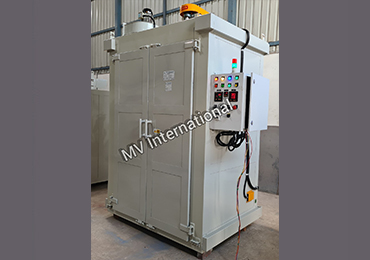
How Industrial Ovens Work: Heating Methods and Applications
Across curing, drying, baking and heat treatment, one machine quietly does the heavy lifting, the industrial oven. Understanding how it works makes it far easier to specify the right one. At its core, an industrial oven is a controlled chamber that delivers uniform heat to a load and holds it there for a set time, and every design decision serves that goal.
The Heating Media
Industrial ovens are built around one of a few heat sources. Electric heating is clean and precise; gas-fired heating suits high throughput and larger chambers; thermic-oil and steam heating tap into existing plant infrastructure. The media shapes the oven's temperature range, running cost and how quickly it recovers heat after loading.
Airflow and Uniformity
Heat is only useful if it reaches the whole load evenly. Forced-air circulation moves heated air through the chamber in a designed path, past the load and back to the heat source, so parts at the back process the same as parts near the door. This circulation is what turns a hot box into a repeatable process tool.
- A heat source: electric, gas-fired, thermic-oil or steam
- A circulation system that moves air evenly through the load
- Insulation that retains heat and stabilises the cycle
- A controller that holds the set point and runs profiles
Where Industrial Ovens Are Used
The same fundamentals appear across very different jobs. A batch oven processes discrete loads for curing and heat treatment; a drying oven drives moisture out of components and materials. The chamber, airflow and controls are tuned to each application, but the working principle is shared.
Batch vs Continuous
Ovens broadly split into batch types, where work is loaded, processed and removed, and continuous types, where a conveyor carries work through the chamber. Batch suits varied or lower-volume work; continuous suits steady, high-volume production. Which one fits depends entirely on how your production flows.
In Short
An industrial oven is a heat source, an airflow path, insulation and a controller, working together to deliver even, repeatable heat. Once you see it that way, specifying one becomes a question of matching those four elements to your process. A heating oven follows the same logic for warming and pre-heating tasks.