


Foundry Core Drying Ovens: How They Work
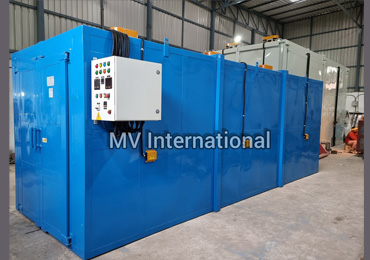
Foundry Core Drying Ovens: How They Work
Sand cores shape the internal cavities of a casting, and they must be dried and hardened before the metal is poured. A foundry core drying oven delivers the even, controlled heat that cures the binder and removes moisture so cores hold their shape under molten metal.
Why Cores Are Dried
Cores are formed from sand bound with a binder, often carrying moisture. If poured against wet or soft cores, the casting can suffer gas defects or the core can collapse. Drying cures the binder and removes moisture, giving the core the strength to survive the pour.
Even Heat Through Dense Loads
Cores are dense and often loaded in quantity, so heat must penetrate uniformly and be held long enough to cure throughout. Forced-air circulation and a controlled cycle bring the whole load, surface and centre, to the required condition together.
- Even forced-air heat through dense core loads
- Controlled cycle to cure the binder fully
- Airflow and extraction to remove moisture
- High capacity for foundry throughput
Where It Fits in the Foundry
Core drying is a key pre-casting step, part of the broader drying oven family and demanding the high-capacity even heat of a robust industrial oven. Dry, hard cores are what make clean, accurate castings possible.
Why It Matters
Moisture or under-cured binder in a core leads to gas porosity, dimensional faults or scrapped castings, defects that are expensive at the pour. Reliable core drying prevents them, which is why a dedicated oven is central to foundry quality.
In Short
A foundry core drying oven cures binder and removes moisture with even, controlled heat, so sand cores hold their shape during casting. It protects casting quality at the source, built on proven industrial oven foundations.